

The Opening Drive 7/13: Todd Monken Among Elite Run Design Play-Callers
The challenge will be bringing his previous run design success to Cleveland.


There is a version of the 2026 Cleveland Browns that wins six games and produces exactly the kind of messy, quarterback-limited football we’ve been bracing ourselves for since the Garrett trade. That version is real and possible. But there’s another version — one where the running game becomes genuinely dominant, where the offense doesn’t need the quarterback to be the answer every Sunday, and where Quinshon Judkins and Dylan Sampson run through defenses in a way this fanbase hasn’t seen since the 2022 season. It’s hard to envision that outcome but it should be considered given what we know about the Browns new head coach and play-caller.
Todd Monken ranks first among all 2026 projected play callers in 10-plus yard designed run rate, at 14.3 percent across 63 career games. That’s not a quirk of sample size. It’s not a product of having Derrick Henry — it precedes Henry entirely. Monken has ranked near the top of this metric throughout his career, from Georgia to Baltimore, because he does something specific and intentional in how he designs run plays. He creates explosives.
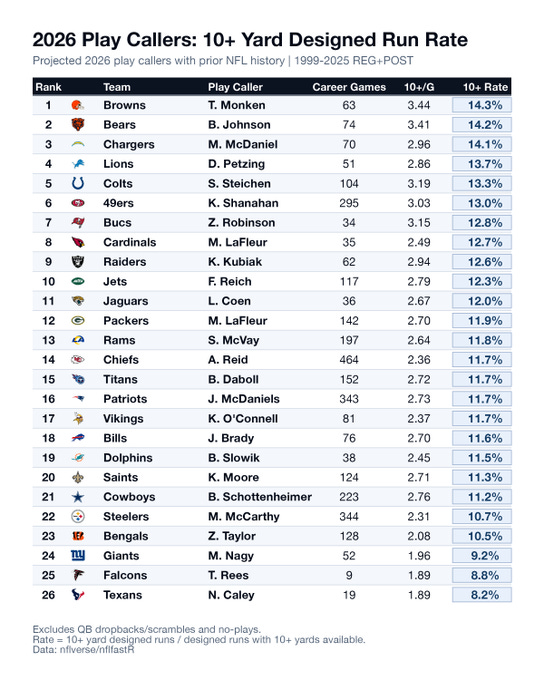
Most run-game conversations focus on yards per carry averages or total rushing attempts, which are useful but blunt instruments. What the 10-plus yard rate captures is something different: how often do designed runs break open for chunk gains? That’s not about the offensive line winning every rep. It’s about the architecture of the play — the blocking scheme, the motion and pre-snap window dressing, the way the ball carrier is given an alley rather than a gap. Monken excels at this. Kyle Shanahan, the closest modern comp to what Monken is building in Cleveland, ranks sixth on this list at 13.0 percent across nearly 300 career games. The fact that Monken tops him after just 63 is worth sitting with.
What makes the number more interesting is who it was built with. People remember Derrick Henry’s 2024 season in Baltimore and reasonably credit Henry. But Monken’s run game was explosive before Henry. At Georgia, he was designing schemes that produced chunk runs against the best defenses in college football. In Cleveland briefly during the Freddie Kitchens year — a poor offensive environment by almost any measure — the run game showed flashes of the same architecture. The common denominator isn’t the personnel. It’s the design and timing.
In the coming weeks ahead of camp, I will break down more of what has made Monken’s run game so difficult to defend and which schemes he prefers to use for chunk plays.
Below you’ll find the latest in the BFB catalog for supporters to dig into. Click the link to become a supporter if you haven’t already, and enjoy all the latest from Browns Film Breakdown.
Latest Podcasts:
Latest Articles:
Opening Drive 7/10: Harold Fannin Jr. Among the NFL's Top Tight Ends According to League Evaluators
Opening Drive 7/8: Browns Individual Talent Appearing Across Top NFL Rankings
Latest Film Rooms:
FILM ROOM: Jared Verse Run Defense Reps and Development Potential
FILM ROOM: Parker Brailsford's Draft Pick Profile and Scouting Report
FILM ROOM: Austin Barber's Draft Pick Profile and Scouting Report
FILM ROOM: Emmanuel McNeil-Warren's Draft Pick Profile and Scouting Report
FILM ROOM: Denzel Boston's Draft Pick Profile and Scouting Report
FILM ROOM: KC Concepcion Draft Pick Profile and Scouting Report

This is the part that should genuinely excite Browns fans about Quinshon Judkins specifically. Judkins isn’t a power back who grinds for four yards and falls forward. He’s a vision runner — a guy who reads blocks as they develop, changes direction without losing speed, and has the contact balance to turn a six-yard gain into twelve. That player profile is essentially the ideal Monken back. When you put a decisive, fast-reading runner into a scheme that generates explosive lanes rather than asking him to create everything himself, you get big plays. You get touchdowns. You get the kind of run game that keeps offenses out of third-and-long, which is imperative for a team still sorting out its quarterback situation.
Dylan Sampson is the second layer of this conversation that hasn’t fully landed yet. His rookie year run attempts nearly disappeared after Week 1 despite strong receiving production throughout, which was a usage mystery I could not fully understand. This year, with a play-caller who designs explosive runs built into the system rather than improvised, the structure exists for Sampson to get the appropriate carries. Monken has historically distributed rush attempts between multiple backs when the scheme creates opportunity for both — the Ravens ran Henry heavily but also used Lamar Jackson and a rotation of backs situationally. Cleveland’s version of that rotation, without a running quarterback, probably looks like Judkins as the primary with Sampson earning 10-12 designed carries a game in the right looks.

The qualifier that any honest accounting has to include is this: Monken’s run game rate was built with better offensive lines than the one he’s inheriting. Georgia and Baltimore featured multiple All-Pro caliber blockers. Even his 2019 Browns offensive line had a strong core. The 2026 Browns are asking Spencer Fano — a ninth overall pick who hasn’t played a professional snap — to anchor the left side. They’re asking Parker Brailsford to compete for the center job. They’re asking a group that graded relatively average across the board last year to suddenly generate the blocking windows that produced a 14.3 percent explosive run rate. It might take some patience for this group to understand what it takes.
But the design of the scheme is precisely what matters here. Monken’s run game doesn’t require every blocker to win his individual rep. It uses motion, misdirection, and calculated double-teams to manufacture leverage rather than demand it from five linemen simultaneously. It’s the reason even modest offensive lines in his system produce more chunk runs than you’d expect. It’s the reason the number at the top of that list isn’t Shanahan — whose run game is excellent but requires a different precision — or Andy Reid, whose Chiefs have used the run game as a complement rather than a feature. It’s Monken, who has figured out how to make the run game dangerous regardless of the talent ceiling around it.
Also, don’t forget offensive coordinator Travis Switzer who followed Monken to Cleveland following their successful stint with the Ravens run game. His presence will matter because his history with Monken is seamless and one that relies on trust and timing.
“He was our run game coordinator, and that's where it all starts with your ability to run the football. So, he's ready for this challenge. He's intentional, he's intelligent and he can teach."
-HC Todd Monken on new Browns OC Travis Switzer
The Browns’ offense this year will live and die by whether the quarterback position can sustain drives and give the run game the proper game-script context to operate. Nobody is pretending otherwise. But when the game script cooperates — when they’re not trailing by 17 and forced into constant 11-personnel and empty packages — the architecture of this run game should produce results that look different from anything Cleveland has fielded in years. Judkins healthy, Sampson involved, and a coordinator who ranks first in the league at turning designed runs into chunk plays. That combination isn’t a guarantee of anything. But it’s worth paying attention to before we decide what this offense can and cannot be.
AYOs: DC Mike Rutenberg on the NFL Spotlight Podcast, Top-10 NFL Quarterbacks for 2026, $9.162 BILLION for the Seahawks, One breakout player for every team in 2026, NFL continues to struggle hiring diversity, Browns players simply cannot pronounce Ohio locations
Browns Film Breakdown will return soon with more fresh content.
