

The Opening Drive 7/24: Todd Monken's Schemes to Know -- Outside Zone
One of Monken's primary run blocking concepts meant to keep backside defenders honest and punish a unit who fails to fit each gap.

We’ve covered a slew of trap-based concepts Todd Monken loves to use, and they’re all beautiful in scheme and creative, but they work because the staples work as a baseline. That staple is outside zone. It doesn’t ask for deception and it only relies on execution and forcing a defense to work in unison. It’s a key run concept in Monken’s system that isn’t selling something else at all; it’s selling patience, and it wins by making an entire defensive front declare its intentions honestly before the runner ever commits to a lane.
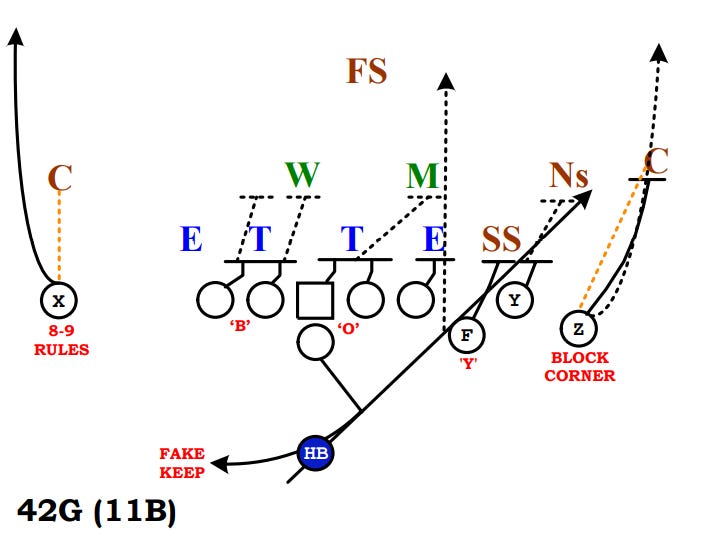
The blocking rules are almost the opposite of trap’s. Instead of leaving one defender unblocked and hitting him from an angle he doesn’t see, outside zone has every lineman taking the same lateral step in the same direction, reaching or “covering” whichever defender lines up in their playside gap, regardless of whether that’s the man they’d normally be assigned. The whole line moves as a unit toward the sideline, double-teaming at the point of attack and climbing to linebackers only once the first level is sealed. There’s no misdirection built into the blocking itself.
The deception, such as it is, happens after the snap, inside the running back’s own decision-making — he’s reading whether the defense has overplayed the stretch or stayed home, and picking a cutback lane based on how the entire front reacted rather than following a design that already picked the gap for him.
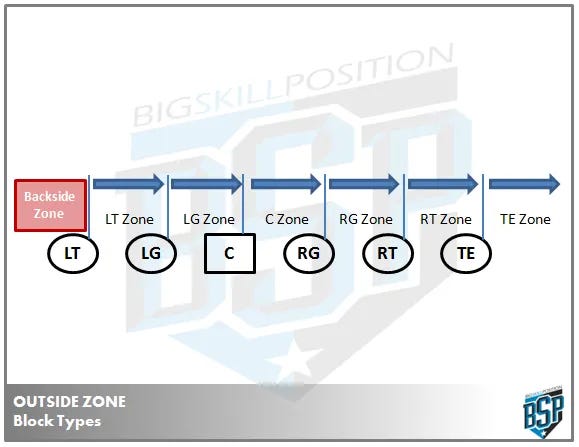
The coaching points underneath that description are where outside zone actually gets won or lost, and they have almost nothing to do with size or power. A lineman’s first step is a lateral “bucket” step at roughly 45 degrees toward the sideline, not a drive step upfield — the aiming point is the playside number of whichever defender is aligned in the next gap over, not the man lined up directly over him. That’s the “covered versus uncovered” rule that defines zone blocking: if a lineman has a defender head-up or shaded to his playside, he’s covered and works that man alone; if he’s uncovered, his job is to help double-team the nearest playside threat before climbing to the second level once his partner has the block secured.
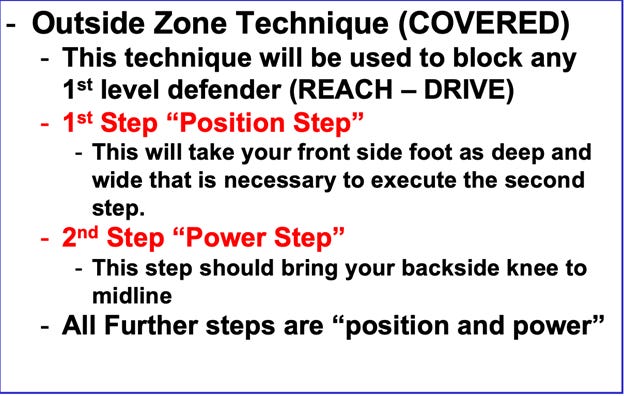
Get that footwork wrong — overstep flat downfield instead of working the proper angle, or come off a double team too early before the linebacker is actually threatening the gap — and the entire line loses its rhythm, because zone blocking depends on every lineman moving in sync rather than on any single block winning in isolation.
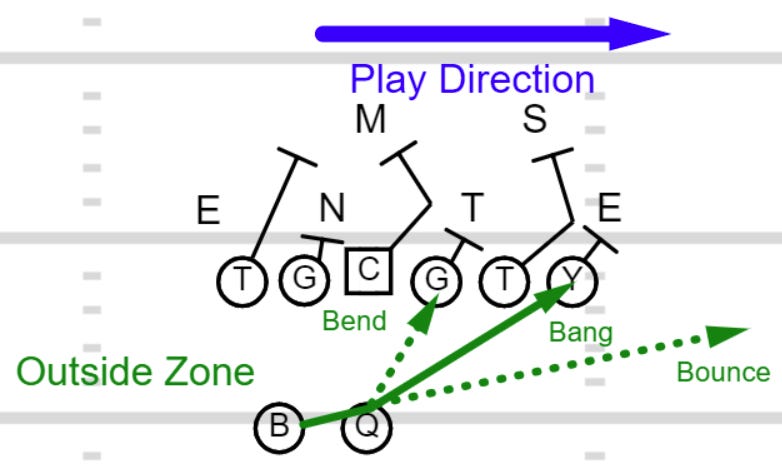
The running back’s job is built on the same discipline in reverse. He’s not picking a hole before the snap; he’s tracking a landmark, usually the outside hip of the playside tackle, and reading the block in front of him in real time to decide among three answers coaches shorthand as bang, bend, or bounce — hit the play downhill if the double team creates immediate movement, bend it backside if the frontside is clogged but the backside cutoff block has sealed a cutback lane, or bounce it outside the tackle if the defense has overplayed the interior. That’s the entire premise of why the concept doesn’t need a lie: the defense is shown the truth of where the double teams are working, and the back’s whole job is reading that truth correctly and late enough that he isn’t guessing. A back who commits to a lane too early is playing a different, worse version of the same concept trap punishes on the defensive side of the ball — aggression without patience, just in the backfield instead of at the line of scrimmage.
Below you’ll find the latest in the BFB catalog for supporters to dig into. Click the link to become a supporter if you haven’t already, and enjoy all the latest from Browns Film Breakdown.
Latest Podcasts:
Browns Standing in NFL's Under-25 Talent Rankings, and "26 for 26" Continues with Harold Fannin Jr.
Browns Make a Move in the Secondary, and "26 for 26" Continues with Spencer Fano
Latest Articles:
Opening Drive 7/23: Todd Monken's Schemes to Know -- Pin and Pull Sweep
Opening Drive 7/22: The Dilemma Facing Browns Fans In 2026 and Where I Have Landed
Opening Drive 7/21: Todd Monken's Schemes to Know -- Trap Influence and False Pulls
Opening Drive 7/20: Todd Moken's Schemes to Know -- Wham and Crunch
Latest Film Rooms:
FILM ROOM: Jared Verse Run Defense Reps and Development Potential
FILM ROOM: Parker Brailsford's Draft Pick Profile and Scouting Report
FILM ROOM: Austin Barber's Draft Pick Profile and Scouting Report
FILM ROOM: Emmanuel McNeil-Warren's Draft Pick Profile and Scouting Report
FILM ROOM: Denzel Boston's Draft Pick Profile and Scouting Report
FILM ROOM: KC Concepcion Draft Pick Profile and Scouting Report

That single-cut, patience-based structure is exactly why the concept has been such a fit for the backs Monken has had in Baltimore. Derrick Henry doesn’t have to be the fastest back on the perimeter for outside zone to work for him — he needs contact balance and the vision to identify a crease late, both of which are strengths he’s built a Hall-of-Fame case on. PFF’s tracking of Baltimore’s run-scheme mix put the Ravens at roughly 40 percent zone-blocking concepts against 49 percent gap schemes in the 2023 season, which tells you outside zone was never the dominant call in Monken’s offense — trap, duo, and gap concepts carried more of the load overall. But the aggregate results across his three years as play-caller speak for themselves regardless of how the workload split by concept: Baltimore led the NFL in rushing yards from 2023 through 2025, racking up 8,512 yards at 166.9 yards per game over that span, the best mark in the league over that stretch by a meaningful margin. and in Monken’s tenure alone they led the NFL in outside zone rush yards per carry (5.7).
Keep reading with a 7-day free trial
Subscribe to Browns Film Breakdown to keep reading this post and get 7 days of free access to the full post archives.